Sunday, October 03, 2010

Pinot Gris, It's not you it's me


I don't hate Pinot Gris. I just wanted to get that out there because people seemed to have the impression that I do. I love wine too much to hate any grape. For me what makes wine so exciting is the possibilities. Between the grape, the viticultural practices, the fermentation and the wine making techniques there's enough potential to cause the indecisive to have a nervous breakdown. Then when you throw in the variation that a cool climate blesses Ontario with you really have limitless possibilities. All of that conspires together in this little thing that drives any wine lover. I'm talking about the search for that one perfect wine from that one perfect vintage that suits you perfectly. You might not ever attain that perfection because as your tastes develop and as you learn more it can become a bit of a moving target. But if you've got the bug (if you're reading this you do) you're going to get damn close tasting a lot of great wines made by some passionate and amazing people. And you'll have lot of fun along the way doing it.

From Taste Gris


For me I'm not sure that one 'perfect' wine will ever come from the Pinot Gris grape. Although I haven't been privileged enough to visit the Alsace, which arguably produces the finest examples of Pinot Gris in the world, I have been lucky enough to visit Oregon's Willamette Valley home of the world's largest producer focused on top-quality Pinot Gris and BC's Okanagan Valley where it only trails the citizen-of-the-world that is Chardonnay in tonnage and value.I didn't fall in love with Pinot Gris during my visits there. The many wines I tried had lovely aromatics, but didn't really give me a whole lot more. That's what frustrates me about Pinot Gris. When I give it a swirl and lean into my the glass I get a wonderful nose full of flowers, pears and melon that sweetly entice me into to taking a sip. Once I take one that promise is almost never fulfilled. Although I love a wine that can beguile me a little it can only get by on its charming nose for so long before it has to deliver in other ways. Instead of doing that Pinot Gris just makes me long for aromatic varieties like Riesling, Viognier, Gewürztraminer and Pinot Noir where I get an experience that satisfies on my tongue just as much as it on the nose.

I'm glad I wrote the initial tweet which inspired the whole #TasteGris event if for no other reason than it brought friends beyond the virtual community of Twitter into one room where we could share, discuss and taste together. That being said it really was a great learning experience for me. There were some very good wines, but more importantly there was a breadth of flavours and styles that prove it would be foolish to outright dismiss the grape entirely.

From Taste Gris


Some of my favourites of the afternoon were the 2009 Fielding Estate Rock Pile Pinot Gris with its peach, pear and the smallest hint of barrel spiciness. The partial barrel fermentation provided a beautifully rich mouth feel but there was also a nice lively acidity. In a single word: balanced. The Stoney Ridge Excellence from 2009 also had a a beautiful floral nose and delivered with peach and pear on the palate. It was interesting to experience the vintage variation between the 2009 and 2007 Thirty Bench Pinot Gris. According to the technical notes both wines were more or less made the same and yet the oak influence seemed to come through much more clearly on the 2009. The 2007 has a bit of pink easer on the nose before giving way to the pear, peach and melon. The mouth feel was quite rich on both making a strong argument for barrel fermentation. So was the difference primarily from vintage variation between the hot and dry 2007 and the cooler and wetter 2009 vintage? Or is it mainly the extra two years of bottle aging that the 2007 has over the 2009?

From Taste Gris


Lastly the 1992 Domaine Zind Humbrecht Clos Saint Urbain Rangen de Thann Grand Cru Tokay Pinot Gris really was something special. The beautiful golden colour, the botrytis influence of apricot and peach, the slight spiciness, the rich oily mouth feel and balancing acidity all added up to one magnificent wine. It was a bit of a revelation for me. Enough to make me a Pinot Gris lover? No, but certainly more than enough keep Pinot Gris in running to be the 'one' wine for me.

From Taste Gris


P.S. A big thank you goes out to Sandra Oldfield for organising the BC contingent of the our Pinot Gris line-up. We don't often get to taste BC's wines here in Ontario so it was privilege to get a taste of the Okanagan for this event. An extra special thanks goes out to Rick VanSickle for organising this even in my honour. Not only is he a true gentleman but he's a true ambassador for Canadian wine and Niagara wines in particular.

Thursday, August 12, 2010

The Curious Controversy of Scarpetta Toronto

Would you eat at restaurant that featured no Ontario wines on its list? That question is at the heart of a debate over the newly opened restaurant at the boutique hotel Thompson Toronto.

Last week a tweet went out from a Niagara wine rep. looking to sell some his wines at the Toronto outpost of Scarpetta . It read " 'I have no North American wines on my list and never will.' sommelier of Scarpetta."

That's a bold statement for any business that relies on pleasing people, let alone a newly opened restaurant in a luxury hotel where the average room rate is around $300 per night. Curiously it was proceeded by an open letter praising Niagara farmers, purveyors and chefs—it even mentioned the quality of the wines. As you can imagine the initial responses were swift and passionate on Tuesday. Things got even more heated after Friday's retweet.

Now if I can digress for a moment, Twitter is unparalleled in its instantaneous ability to share our experiences and create an environment for a lively conversation. We're certainly all the richer for it. Unfortunately the 140 character limit means there's often no room for context, tone or anything beyond the barest of ideas. It also means that sometimes consequences aren't fully considered and information can move faster than it can be verified.

Given the bold statement and the reactions I decided to phone the restaurant and find out for myself. It was confirmed that there were no North American wines carried. The wine list was primarily focused on Italy with some Old World (read other European countries represented). The chef thought the Italian wines fit best with the food, I was told. When I pointed out that no Ontario options was an odd disconnect, given the praise for them in the open letter, the response I got was an agreement that it was a little confusing. I wasn't speaking to the sommelier, manager or anyone who had input into the list's creation, so the staff member's ability to speak to the matter was limited. But I was told that the position could change and the young restaurant is looking into improvements based on customer feedback. Although these were fair answers I decided to contact chef Scott Contant. After all as the author of the letter and the executive chef he is probably the authority best suited to speak on the matter.

Excutive Chef Scott Contant was polite, professional and responsive throughout our email exchange. He certainly had no obligation to speak to me especially given that I haven't spent a penny at his restaurant.

Regarding the tweet about North American wines Contant wrote "I can assure you that quote was never uttered from someone on my team. I take pride in being inclusive as opposed to ex-clusive."

I have no intention on getting into a debate over exactly what was said. I wasn't there but the parties involved know what was said. An Ontario wine representative has nothing to gain by potentially alienating restauranteurs in the province's biggest market. Similarly in a business where reputation is everything and there is a high first year failure rate, a newly opened high-end restaurant has nothing to gain by potentially turning-off pro-local customers.

Conant went on to stress that all suggestions and the criticism are key to helping him remain relevant to his customers. Contant also wrote that staff are considering and exploring many things to improve the restaurant, including expanding the wine list with local options, particularly those made with Italian varietals. If Scarpetta does do this in the future the options might include Pillitteri wines from the newly planted Corvina, Rondinella and Molinara (these were the first of their kind planted in Canada). There's also Alvento's Nebbiolo or Ridgepoint's. And the wines of Foreign Affair are made using the appassimento method.

The larger part of the debate that occurred in wake of the tweet was whether a diner should expect a local option at a restaurant, especially an ethnic one. I talked to Conant about what I saw on his menu. It largely draws on the cusines of Piemonte and Alto Adige with hints of Emilia–Romagna.

It's important to recognise that Italy is still very much a regional country with people being unable to understand the other's regional dialect. Where, this really expresses itself is in the cuisines. People the next region over not only don't, but won't eat the same dishes because their food is 'best'. So naturally it makes sense to feature the wines of a region with its cuisine. The aforementioned regions have a long history of hundreds of years where the cuisine and wine developed and evolved side-by-side and naturally are crafted to complement and enhance one another.

Interestingly the Northern Italian regions of Piemonte and Alto Adige are as much if not more influenced by boarding Swizterland and Austria as they are by the rest of Italy. So they grow and drink Riesling, Gewürztraminer, Pinot Gris & Pinot Blanc. There are plenty of great Ontario examples of those varieties.

A restaurant is certainly free to stock whatever it feels matches best with it cuisine & what will sell. Like a menu, a particular focus to a wine list is always best, but it does help to have some breadth to cover a range of tastes and preferences—otherwise you risk losing sales. Still it certainly can be interpreted as bit of a snub to open-up a high-end restaurant in Toronto and not list any Ontario wines. Granted Niagara is a very young wine region, but if a similar restaurant opened in San Francisco and did not list any Napa-Sonoma wines there would likely be some controversy.

Despite the email exchange I never got a reason why Conant writes "I don't think I need to tell you how great the [local Ontario] wines are, either." in the open letter, yet Scarpetta carries no local (or North American) wines on its list. It certainly seems like a contradiction given the praise for the Niagara farmers & local suppliers in the letter and the use of them.

If this is a non-issue by all means make a reservation and enjoy Scarpetta. If the responsiveness I've received is indicative of the level of service you're in for a wonderful meal. But if this bothers you don't merely vote with your dollars. Let the staff of Sacrpetta know that the lack of Ontario wine options is what's preventing you from trying the food.

Monday, July 26, 2010

What the truck or you can get Good Food in Wine Country Without all the Pretense?

What do you think of when you think food in wine country? At its best it makes use of the fresh seasonal local crop. It's set amongst the idyllic backdrop of the vines. And naturally it pairs well with the local wine. But does it always need to be rooted in classic French technique, amuse bouches, and tasting menus served on white table cloths?

Adam Hynam-Smith and Tamara Jensen are doing all the former out of a truck without all the latter because sometimes you just want tasty seasonal food without all the formality.

Hynam-Smith, a passionate and adventurous Aussie, has some serious cooking chops. He learned under Michelin-starred Jacques Raymond at his eponymous Melbourne restaurant. He also worked under Cath Claringbold at the well-regarded Mecca. It was there that he developed a love for Middle Eastern and North African flavours that he would expand upon in a trip to Morocco. That lead to traveling and working throughout Europe where he met Canadian Tamara Jensen. After further culinary travels in North America, the Caribbean and South-East Asia the couple settled in St. Catherines unable to resist the beauty and bounty of Niagara. They now run Peapod Cuisine.

From El Gastro


But he's all very modest about his cooking accomplishments and is much more interested in where I learned about the food of the Middle East and North Africa and what I thought of his food than talking about himself.

The idea for El Gastrónomo Vagabundo took shape at a local wine event where after enthusiastically enjoying some of Niagara's best Hynam-Smith talked to Ed Madronich. After an expensive catering quote proposing an uninspired menu, Madronich had Peapod cater Flat Rock's fifth anniversary party. The menu was essentially the essence of El Gastrónomo Vagabundo. The concept was such a hit that Madronich insisted the truck be parked at winery on weekends for the rest of summer.

Things are just getting started for El Gastrónomo Vagabundo serving at Flat Rock for the past two weekends. Staff at the winery's tasting bar enthusiastically invite you to stay for a bite comparing the concept to LA based gourmet taco trucks. The description is mostly correct, if a bit simplistic.

From El Gastro


The location of the truck reminds me of the affectionately named roach coaches (named so because they come out at night) that I came across in Sonoma which feed migrant vineyard workers & savvy tourist looking for break from wine country cuisine. The execution is more like Kolgi where traditional Korean BBQ tastes are delivered via taco and other easily handled Mexican street food. All out of truck which has its menu and location distributed via the Web and Twitter.

Unlike Kolgi the ethnic flavours are more global, reflecting Hynam-Smith training and travels. Thankfully it isn't fusion food because more often than not fusion tends to be a compromise between two ethnic foods that does a disservice to the respective cuisines. There's also a focus placed on local sourcing and minimising the environmental impact.

The set-up is a little strange with liquor laws requiring you to go through the winery and on to green roof patio. But tasting room staff will be happy to lead the way where Jensen and Hynam-Smith will make you feel welcome at picnic tables that overlook the vines and rolling bench landscape.

Given the Middle Eastern theme of the day's menu I thought a garden salad (picked from Hynam-Smith and Flat Rock's gardens) featured sumac for some colour and tart earthy, citrus flavours. It turns out it was beet dust—Aussie's love beets. But Hynam-Smith plans to make use of the sumac trees at Flat Rock to spice items later in the season.

From El Gastro


For me the the highlight was the Fez with lamb seasoned in Ras el hanout. It's sauced in a homemade harissa with a sneaking spice that's hot enough to raise your temperature but not so much that it obliterates the palette. Although the taco is good, it really comes together in bites featuring lemon zest, it's just missing that one elevating touch. When I ask Hynam-Smith about preserved lemons he mentioned that he's making some at home to provide the salty-citrus tang that will get the Fez tasting exactly to his liking. When they're ready I plan to try it again as it should be the missing ingredient that will bring everything together and elevate the layered spicing of the lamb taco.

From El Gastro


Given the hot day and the need for a wine deft enough to go between the different cuisines of the salad, Don Caprese and Fez tacos I ignore the Fez's suggested '08 Gravity Pinot Noir pairing in favour of the mineral and citrus forward '09 Naja's Vineyard Riesling. It gets a little lost in the harissa but the lemon and lime flavours highlight the zest and the acidity cuts through some of the lamb's richness.

Beyond weekends at Flat Rock this summer Hynam-Smith and Jensen hope to take El Gastrónomo Vagabundo to events and private parties. If you're touring the Twenty Mile bench this summer and looking for something different stop at Flat Rock for the duo's evolving menu (which you can get a peak at by following them on Twitter) of seasonal local produce and global cuisines. It's all very much an apt metaphor for the nomadic Aussie whose worldly experience has him exploring and interpreting the flavours of the globe for where he calls home.

From El Gastro

Saturday, July 10, 2010

They Grow-up So Fast

So while we wait for our next work ticket I took the opportunity to look at the progress of our My Wine vines. I have to say what a difference a week makes. After the last post we had a week of rainy weather. As you can see the early start to the season and the water have the vines growing well. Although you can spot a bit of difference in the shoot height and the density of the canopy, you can definitely see it in the berry size. It's getting tough to see any of the stalk in there!


From My Wine


This week we're in the midst of a heat wave not since seen in these parts since 2005 & 2007 . If you're familiar with Niagara vintages those two are known for hot and dry conditions. Now that probably doesn't benefit our Riesling as much as Bordeaux varieties commonly grown in Niagara like Cabernet Sauvignon & Merlot. Hot, dry growing conditions can sometimes lead to a petrol note that's usually associated with more aged Riesling earlier in the wine's life. But if this is any indication we're in good hands should you not care for a hint of fossilised-dino-car-go-juice early in your Riesling's life.


With lush and thick canopy growth like this I have a feeling we're in for a bit of trimming sooner rather than later.


From My Wine

Friday, June 25, 2010

Lookin' Good There, Good Lookin'


Given the early start to cherry season (what's good for tender fruit is generally good for grapes), I thought I would check out our My Wine, My Way vines. Please click the link here to view an album or look below to see a slideshow of how our vines are progressing. Brian Schmidt told me our vines are about six weeks earlier than normal with their vegetative growth (leaves, canes, etc.) and about two weeks ahead of schedule on grape growth progress. Things are definitely looking promising. I'm looking forward to our next ticket, which should be coming soon.


Wednesday, June 23, 2010

Good Things Come to Those Who Wait:

My Wine's First Ticket


It's our first opportunity to make a decision for My Wine, My Way. We're being asked to crop thin now or in August. If we crop thin now it should increase the possibility of more uniformly ripe grapes come harvest time. So if we want to help our chances of making the best possible wine this year it's really a no-brainer decision. Time to get in the vineyard with the shears and get cutting—not so fast.


Coincidentally I've been taking a general viticulture course this summer and the one thing that's stuck above everything else is the underlying theme that it isn't easy or straightforward growing wine grapes in Niagara. Without getting into too much detail, Niagara has a short, humid, wet (especially at harvest) growing season followed by a harsh winter for a grape growing region. So what does this mean for Vitis vinifera, a plant of desert origins? It means certain varieties can be a struggle to ripen fully here. With little to no tricks or intervention cool climate varieties like Riesling need about 1700 growing degree days to fully ripen. Moderate climate Cabernet Sauvignon requires 1900 and the heat loving Grenache demands 2100. Niagara's weather fluctuates yearly affecting the quality of the growing season but it's a cool climate growing region, which is generally considered to be in the range of 1500-1700 growing degree days. The growing conditions in Niagara also mean grapes are susceptible to potentially crop-ruining fungal diseases and the grapes can become water logged or even burst when nearing harvest time. About 550 mm – 850 mm of precipitation per year is ideal for most Vitis vinifera. Niagara usually hits that target before the end of summer and exceeds it by year's end. If the grapes mange to get through all of that unscathed there's still the potential of vine-killing cold and frost severely damaging the buds in spring. Anywhere with winters below -23°C more than once every 20 years is considered unprofitable for viticulture—completely replanting can put you out of production for 3-5 years. Ideally the coldest winter month should average above -1°C. Plus most Vitis vinifera will die if the temperature falls below -15°C to -25°C (depending on the cold hardiness of the variety and clone). Niagara fails everyone of those criteria. It kind makes me glad that the vines our only our's until the Riesling gets made for the My Wine, My Way project.


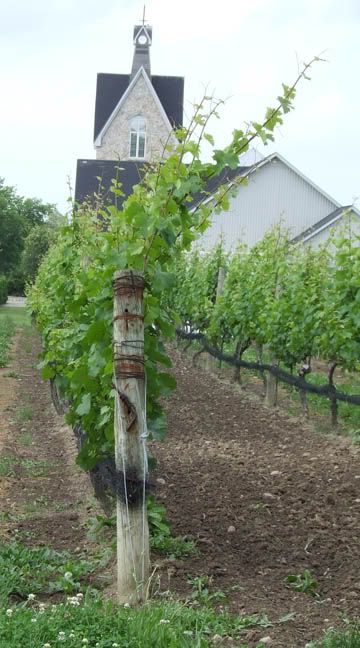
A row of the My WIne, My Way Riesling. You can see Vineland's iconic stone tower in the background.


So what does all this have to do with the decision to crop thin now or in August? As the My Wine, My Wine site explains, if we crop thin now we essentially lighten the vines' loads. The remaining grapes have to fight less for their share of sun, nutrients and other resources—thus more even ripeness. But unfortunately it's not just the grapes that get more of that good stuff. By lightening the load the canes stretch, grower thicker and you don't make wine out of canes. Unfortunately, these suddenly thicker canes have a tougher time getting ready for winter. As you know from the above anything we can do to help the vines prepare for winter is a good first step towards making a great wine next year.


Also if we crop thin now and (knock on wood) something should happen that puts the vines at risk, it would make it very difficult to produce a good wine in decent quantities. Even though the season started off warmer and earlier than usual, the recent moisture and humidity can be dangerous to this year's young grapes. In fact, just the other day there was a risk of severe thunderstorms and hail. I don't know about you but the risks outweigh the potential reward of grapes at harvest that are slightly more ripe vine-to-vine. Besides I'm sure there are some other upcoming wine making decisions that will allow us to help aid the potential ripeness of the grapes without risking next year's crop.


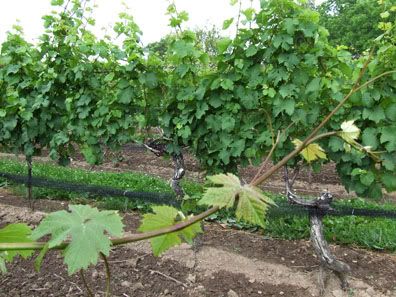
My Wine, My way Riesling vines on June 22nd 2010.

Monday, June 21, 2010

What's Cooler than an idea who's time has come?

This changes everything. You've heard it before but how many times when referring to the Ontario wine Industry?


Vineland Estates, a producer of some of the best Riesling in Niagara (and Niagara makes cellars packed with Melchiors worth of good examples) has an idea so simple and compelling you would swear Steve Jobs had started a winery. Vineland wants to make a Riesling for you and not only do they want you to help make it, but they want you to make it your way.


For any wine lover who always wanted to know more or get involved in the winemaking process in some capacity My Wine, My Way is your chance. Sure you could take a wine making course at your local community college, buy some local grapes come harvest time and then make and bottle your own wine. But this is more than that.


Talk to any passionate winemaker (Brian Schmidt is amongst the most passionate in Niagara) and he/she will tell you that good wines, especially those that come from one particular site, start in the vineyard. No good grapes means no good wine. This community based project will allow wine lovers to participate in all sorts of decisions that will help shape the colour, taste and aroma of the finished wine. Based on a brief explanation of the task at hand and its possible consequences you'll be asked to make decisions about shoot positioning, crop thinning, the harvest date and more.


Brian Schmidt & Vineland's staff will then apply your decisions for you. There may even be the possibility to apply some of these decisions yourself with some hands-on participation in vineyard should you desire.


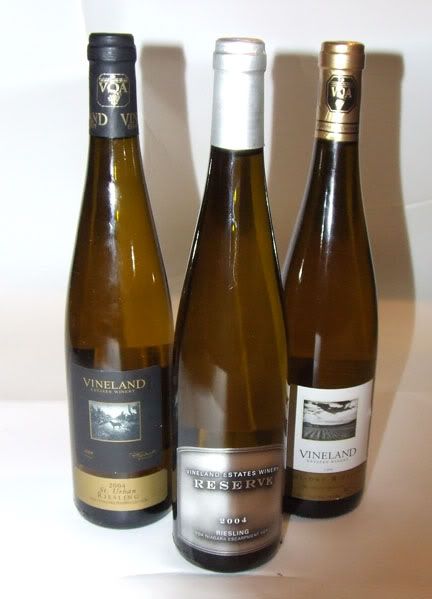
Vineland makes some of Niagara's best Rieslings. Here's a trio from the various tiers. Left to Right: 2004 St. Urban Riesling, 2004 Reserve Riesling. 1999 Semi-Dry Riesling.


But why bother going through the trouble of inviting the public in on the wine making process? I could tell you that the alcoholic beverage market is growing in Canada and wine's share of it is too. I could also tell you that Millennials (18-29 year olds) splurge more of their spending dollars on food and wine than any other group. They are epicureans and their worldly exiperience has their tastes ahead of previous generations. They are constantly connected to the internet, enjoy social media but growing-up with the technology they are both savvy and weary of businesses using them. Still they love being able to opt-in to participate in something genuine, useful, informative, engaging and unique.


But none of the above paragraph is the motivation behind My Wine, My Way. I'll repeat it. None of the above paragraph is the motivation behind My Wine, My Way. When I spoke to Schmidt about the idea behind My Wine, My Way he talked about how he saw it as a unique opportunity to interact with customers on another level and to learn from each other.


You simply have to have one conversion with Schmidt about Niagara wine on Twitter to know he and the staff at Vineland are doing this because they genuinely care about their customers and want to share some of their passion through this unique experience. Brain Schmidt is a tireless champion of Niagara wines promoting the great products of fellow winemakers before his own. He's also a great steward of the wine region taking the time to share his knowledge and passion at every opportunity. I've benefited from this on more than one occasion and always come away impressed, engaged and learning something useful. I believe this is one way he gives back for all the knowlege that he has said he has benefited from via the past and fellow winemakers of the region.


I will most certainly fully take part in My Wine, My Way documenting and adding what I can here. I encourage all Ontario wine lovers to do the same by participating on the website and joining in the conversation on the My Wine Twitter feed . With ideas like this one the present and future of Ontario's wine industry looks bright. This project certainly has potential to spark the passion that I know is driving Ontario's growing wine culture.

Sunday, June 20, 2010

Sharp Chards: of ink & in the glass


If you read the Financial Times or more aptly follow a certain British wine critic who writes in the well regarded publication you might have the impression that Ontario wine industry is at its nadir.


I can't imagine that's what Bill Redelmeier was hoping for when he began genesis of what would become Seriously Cool Chardonnay.


The proprietor of Southbrook was inspired by an interview he heard with Thomas Bachelder on CBC. After besting French and Californian competition at a blind tasting in Montreal the Clos Jordanne winemaker said he felt that there are many Ontario wineries that could have had the same success.


Redelmeier spent the past year calling on Ontario's wineries to submit their best Chardonnays and spearheading a plan to showcase the best of the best to the world. The culmination was a tasting in London on May 17, 2010. The idea was much like a past New Zealand Sauvignon Blanc tasting which begat a world-class reputation for the Kiwi take on the varietal.


By all accounts it was a good showing for the 40 wines (although this still shows 39) from 22 wineries. Like all settings where scoring and judging is involved some distinguished themselves as top performers. Still even the lowest scoring wine was deemed good, decent but unremarkable. Although this wasn't exactly an affirming declaration of quality fit for a Hollywood movie, given that these critics taste the world it is a very respectable result.


Despite this the focus became a continuation of the Cellared In Canada debate, which began last year and spilled into this one. As Rick VanSickle pointed out, not only was it disrespectful to the spirit of the tasting, but focusing on something unrelated to the tasting certainly leaves readers with the implication that Canada's world-class Chardonnay is secondary news.


Another curious thing about the post-tasting coverage was the highlighting of Prince Edward County Chardonnay as "distinctive". Although it was encouraging to see two Prince Edward County producers receiving top scores, seven of the top eight scores awarded were for wines made with Niagara fruit. With all due respect to the passionate and inventive producers of Prince Edward County, Niagara has a good 15 years more experience to draw-on. It also seems at odds to me to write that Prince Edward County's colder climate results in a Burgundian elegance when it comes to Chardonnay yet describe the top scored wine using county fruit as big, bold and Californian in style.


Even though the event went very well, it certainly could have gone better. The scores only began trickling in almost two weeks later. That's a generation ago in today's news cycles. Still that would not have seemed so long had there been any hint of a word on when to expect news to begin coming in. Also now that the scores have come there doesn't seem to be much of an indication of whether the initiative continues and if so where does it go from here.


Still you can't argue with the assement that our best can hold their own in a competition with world's best. It isn't just chardonnay either Hidden Bench certainly showed that in 2010 Decanter World Wine awards. Now if we could just make the focus the positives and highlight the best of the Ontario Wine industry with it's VQA wines both the industry and the consumer will benefit.